
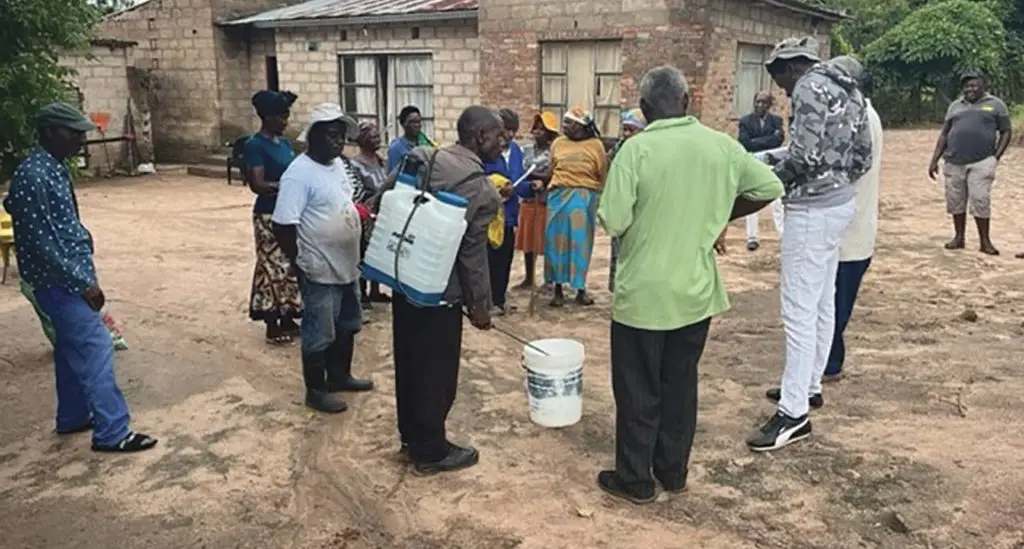
Sprayer calibration must be done to ensure you spray the correct amount of spray mixture (water and the registered crop-protection product) onto the desired area. Farming is about profit, and the correct application of herbicide or pesticide can improve your profit. A once-off calibration is not enough – calibrate before the spraying season begins and recalibrate frequently throughout the season.
HANDY HINT
If you know the field size, compare the volume applied with the calculated volume required. For instance, if you spray 300 ℓ of water per hectare and the field is 10 ha, you should have applied 3 000 ℓ of water.
You only need a stopwatch or timer, which most cellphones have, a measuring jug (marked in ml) and a measuring tape. In principle, you want to calculate how much water is sprayed per hectare.
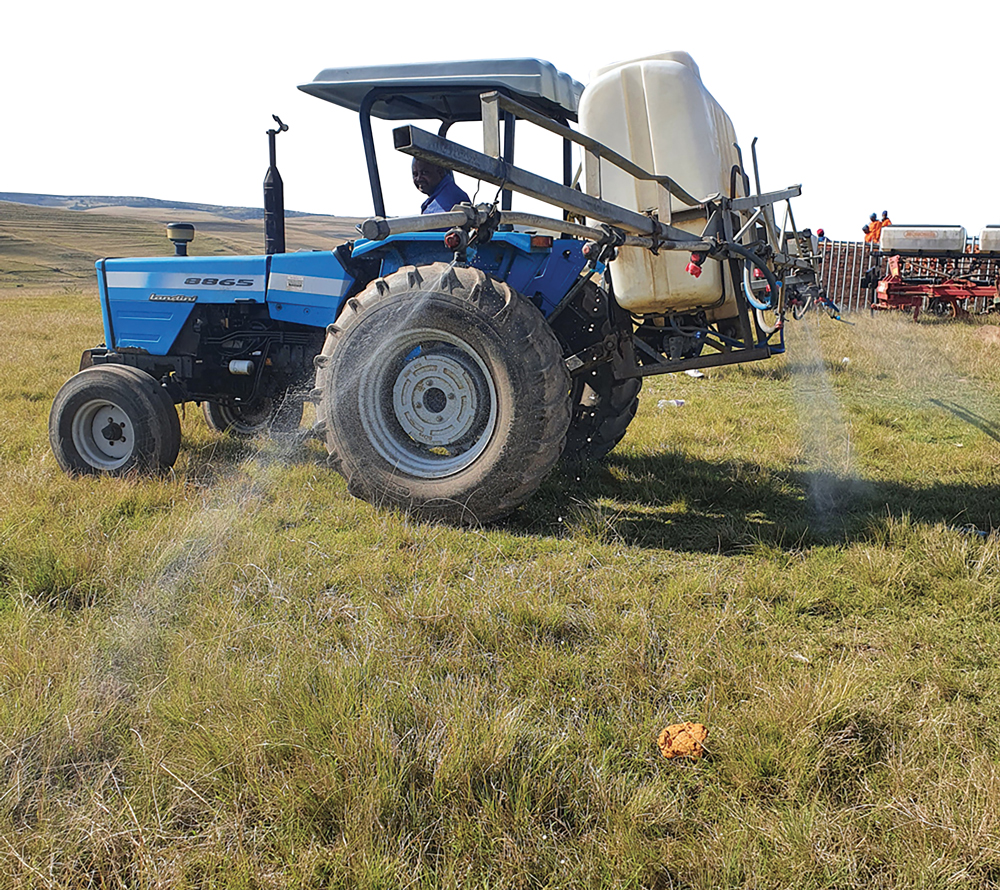
CALIBRATING A BOOM SPRAYER
Clean the sprayer tank, filters and nozzles. Make sure all nozzles are the same type and colour, and that the sprayer pressure matches the nozzles’ requirements.
Measure a distance of 100 m on the farm road. Use a measuring tape and mark both ends of the 100 m course with stakes. Fill the sprayer tank with clean water. Decide which gear will be used and at which revolutions per minute (RPM) – e.g. fourth gear at 2 500 RPM. Remember it is difficult to drive a tractor with a sprayer accurately, so don’t go too fast. Now measure the time that it takes for the tractor to cover the
100 m – for example, 60 seconds.
Run the tractor stationary at the agreed 2 500 RPM and check the spray coverage on the ground. Set the pressure on the sprayer to give the desired effect (e.g. 3 bar). Using the same time that it took the tractor to cover the 100 m, engage the spray and measure the amount of water produced by catching the water delivered by one separate nozzle. Normally, you can use a few clean 2 ℓ bottles to catch the water delivered by letting the nozzle spray into the bottle, for example, 1 200 ml/1,2 ℓ for 60 seconds. Make sure that your measuring containers are clearly marked and will never be used for food or drink, as it may contain pesticide residue.
Use the average amount of liquid produced by one nozzle (for example, 1 200 ml/1,2 ℓ) and multiply this by the number of nozzles so that you know how many litres you are spraying out over 100 m. With all the nozzles in this case: 28 x 1,2 ℓ = 33,6 ℓ.
Measure the width of the boom (for example, 14 m). Now you know the width you are spraying and the amount of water you are spraying over that width over 100 m. The area covered by the sprayer over 100 m is 100 m x 14 m = 1 400 m². On this area, 33,6 ℓ of water is used. An area of 1 ha is equal to 10 000 m² (100 m x 100 m). The volume to be used on 1 ha will be 10 000/1 400 = 7,14 x 33,6 ℓ = 240 ℓ/ha.
To make sure your calculation is correct: If your nozzles are 500 mm apart, take the delivery of one nozzle and multiply it by 200. In this case, 1,2 ℓ x 200 = 240 ℓ/ha, which confirms the calculation is correct.
The label on the chemical container will indicate the amount of water required per hectare, as well as the amount of product required per hectare.
CALIBRATING A KNAPSACK SPRAYER
Measure 50 m using a measuring wheel or tape measure. Walk up and down the 50 m and measure the time it takes to cover the distance (50 m + 50 m = 100 m). Remember to walk at a steady pace, as you will need to maintain that speed. The faster you walk, the less liquid you will spray onto a particular area.
Spray liquid from the knapsack sprayer into a measuring jug for the same number of seconds that it took you to walk the 100 m. You will now know how much liquid you would have sprayed out onto the 100 m. Example: Suppose you sprayed 1,75 ℓ of water into the jug. You know then that you will use 1,75 ℓ of water for every 100 m walked.
It is now necessary to calculate the number of rows in 1 ha. As you know, 1 ha is 100 m by 100 m. Assuming the row width is 0,9 m, there are 111 rows in 1 ha. If the liquid in the jug is 1,75 ℓ you will use 1,75 ℓ on one row. With 111 rows in 1 ha, which means to cover the whole hectare, you will need 111 x 1,75 ℓ of liquid = 194 ℓ/ha in total. The chemical label will indicate the amount of the specific chemical to apply per hectare or per 194 ℓ of water.
You now have the following options:
- Fill a container with 194 ℓ (a standard large drum is 200 ℓ) and pour in the chemicals required per hectare. Stir well and continue stirring regularly to avoid the chemicals settling. You can then use this premix to fill your knapsack or spray tank.
- If you are using several smaller water containers, for example 20 ℓ containers, or even if putting chemicals directly into the knapsack sprayer, multiply the concentration of the chemical per litre by the number of litres that the container holds.
Publication: November 2026
Section: Pula/Imvula
Author: Article adapted from an article in Pula October 2024.
