2026 UKUKHULA CONFERENCE STRENGTHENS THE FOUNDATION FOR AGRICULTURAL TRANSFORMATION
PGP Day of Celebration honours growth, resilience and excellence among South Africa’s developing grain farmers
NAMPO Park, Bothaville – A significant proposal to advance land ownership for qualifying developing farmers, alongside a renewed call for coordinated support and commercial profitability, took centre stage at the 2026 Ukukhula Grain & Livestock Conference, hosted by Grain SA’s Phahama Grain Phakama (PGP) in partnership with Red Meat Industry Services (RMIS) on 8 October 2026.
Held under the theme “Strengthen the Foundation”, the second annual conference brought together farmers, government, financiers, insurers and agricultural industry leaders in a farmer-centred platform focused on practical solutions to the barriers limiting agricultural growth and transformation.
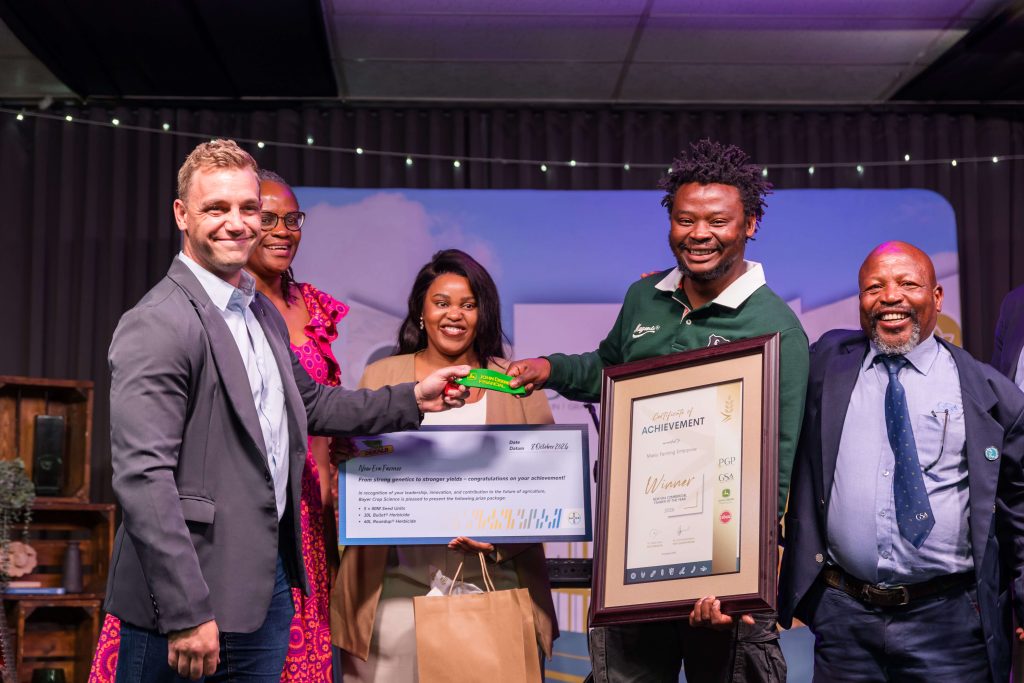
The day’s discussions culminated in PGP’s annual Day of Celebration, recognising four outstanding Farmer of the Year winners and farmers reaching important milestones in their development journeys.
From dialogue to action: Land ownership in focus
A key development emerged during the opening address by Minister of Agriculture Willie Aucamp, who announced an initiative agreed upon with the African Farmers’ Association of South Africa (AFASA) to identify 100 qualifying black farmers per province who are productively farming on state-leased land, with the intention of pursuing the transfer of ownership through engagement with the Department of Land Reform and Rural Development.
The proposal represents a potential step towards addressing one of the most persistent barriers facing developing farmers: the inability to secure investment and commercial finance without recognised, bankable land rights.
Aucamp stressed that meaningful transformation must result in viable and productive farming enterprises, with profitability remaining central to long-term sustainability.
PGP Chairperson Jeremia Mathebula welcomed the initiative, highlighting the confidence, dignity and investment opportunities that secure land ownership could provide.
“We’re not going to keep quiet until those deserving farmers get their title deed,” Mathebula stated during the land-tenure discussion.
He emphasised that, without ownership or sufficient collateral, farmers struggle to access the capital necessary for mechanisation, infrastructure and expansion into value-adding activities such as agro-processing.
However, discussions also recognised that ownership alone is not a complete solution. Farmers require access to water, infrastructure, finance, markets and technical support to unlock the productive potential of their land. Particular concern was raised over the position of farmers operating on communal land, where conventional financing requirements often remain a barrier despite demonstrated production capacity.
Measuring transformation by results, not numbers
Building on the inaugural Ukukhula Conference in 2025, this year’s discussions challenged stakeholders to move beyond measuring farmer development by the number of beneficiaries assisted or hectares allocated.
Opening the conference, Mathebula called for development programmes to be assessed according to tangible commercial outcomes: increased production, improved profitability, job creation and farmers progressing towards independent commercial operations.
“South Africa does not have a shortage of capable farmers. What many farmers need are the conditions that allow capability to become productivity, productivity to become profitability, and profitability to become sustainable commercial success,” Mathebula said.
The transformation and farmer-development panel, featuring provincial government representatives, industry stakeholders and farmers, highlighted the need for greater coordination between government programmes, commodity organisations and private-sector initiatives.
North West MEC Madoda Sombatha highlighted the fragmentation of farmer-support programmes, calling for development pathways with clearly defined milestones and improved alignment between government and existing industry initiatives.
Free State MEC Elsabe Rockman emphasised that effective transformation also requires addressing the structural conditions facing farmers, including access to water, infrastructure and markets.
Farmer Dr Dan Mosia called for a shift from production-led towards market-led development, where farmers are supported not only to produce crops, but also to secure sustainable markets and profitable prices.
Together, the discussions reinforced the need for an integrated approach that places the farmer at the centre of development.
Finance, risk and diversification: Building resilient enterprises
Access to agricultural finance remained a central challenge, with representatives from Kagiso Trust, Khula!, Land Bank, Kgodiso Development Fund and FNB participating in discussions on unlocking capital for growth and profitability.
The programme examined the importance of blended finance, appropriate collateral arrangements, risk-sharing and business readiness to enable farmers to transition from development support towards commercial funding.
Climate resilience also received attention, particularly amid concerns about potential El Niño conditions and their impact on grain production. Agricultural and insurance specialists explored risk mitigation, weather-related insurance and the importance of preparing for increasingly unpredictable production seasons.
The partnership between PGP and RMIS strengthened the focus on grain and livestock integration as an opportunity to diversify income, improve resource utilisation and build greater resilience into farming enterprises.
Parallel breakaway sessions for commercial, smallholder and subsistence farmers ensured that discussions addressed the different needs of producers, from fundamental production practices and mentorship to financing, insurance and business expansion.
Across the sessions, a consistent message emerged: agricultural transformation cannot depend on isolated interventions. Land, finance, practical knowledge, infrastructure, markets and accountability must work together to create commercially sustainable farming enterprises.
Growing Together: Celebrating excellence in farmer development
As the conference concluded, attention turned from the challenges facing developing farmers to the achievements being realised on farms across South Africa.
The annual PGP Day of Celebration, held under the theme “Growing Together”, honoured farmers whose determination, willingness to learn and commitment to improving their operations demonstrate the impact of sustained farmer-development support.
Four national winners were recognised across the development programme’s Farmer of the Year categories:
2026 Grain SA/Absa/John Deere Financial Subsistence Farmer of the Year: Manqoba Nkosi – Donkerhoek, Piet Retief, Mpumalanga
Producing maize and soybeans alongside livestock, Nkosi has demonstrated steady progress through improved production practices and a commitment to continuous learning. Having joined Grain SA’s development programme in 2016, he continues to build on his agricultural knowledge and strengthen his farming enterprise.
2026 Grain SA/Land Bank Smallholder Farmer of the Year: Lubabalo Jordan – Bangilizwe, Mthatha, Eastern Cape
After working in engineering in South Africa and abroad, Jordan returned to his family’s agricultural roots. His maize production has expanded from 3 hectares to 13 hectares since joining the programme, while his leadership as chairperson of the Bangilizwe study group reflects his commitment to supporting fellow farmers.
2026 Grain SA/Pannar Potential Commercial Farmer of the Year: Kopano Lentswetshipi – Mooifontein, Lichtenburg, North West
Starting with 45 hectares entrusted to him by his father in 2014, Lentswetshipi has expanded his production to approximately 200 hectares. Through investment in mechanisation and improved business administration, he is steadily building a more commercially focused farming enterprise.
2026 Grain SA/Absa/John Deere Financial New Era Commercial Farmer of the Year: Masiu Farming Enterprise – Senekal, Free State
The Masiu family’s diversified farming operation produces maize, soybeans and sunflower alongside a Bonsmara cattle herd. Its progression, including the acquisition of a 700-hectare farm, reflects the importance of sound management, diversification and a long-term commitment to commercial agricultural growth.
Beyond recognising the four winners, the evening celebrated farmers graduating through PGP’s production-based club categories, acknowledging the incremental achievements that form the foundation for continued growth.
The success stories demonstrated that transformation is not a once-off intervention, but a journey in which knowledge, opportunity, resilience and consistent support translate into measurable progress.
Partnerships driving sustainable progress
The conference and Day of Celebration highlighted the role that collaboration continues to play in building a more inclusive and competitive agricultural sector.
PGP acknowledged the contributions of its farmers, mentors, sponsors, industry partners and participating institutions, whose continued support makes practical farmer development possible.
The evening also marked a leadership milestone with the introduction of Khomotso Mashiloane as the incoming Chief Executive Officer of Phahama Grain Phakama.
In welcoming Mashiloane, Mathebula expressed confidence in building on the organisation’s achievements and continuing to strengthen its capacity to support developing farmers.
The success of the 2026 events was made possible through collaboration with RMIS and the support of industry partners, including Absa, John Deere Financial, Pannar Seed, Land Bank, Bayer, Hollard, Santam, Kagiso Trust, Kgodiso Development Fund and Khula!.
A platform for solutions and a celebration of progress
The 2026 Ukukhula Conference reinforced the importance of turning policy discussions and industry collaboration into practical action on farms.
While the land-ownership initiative presents a potential opportunity to address a longstanding structural barrier, the broader message remains clear: sustainable agricultural transformation requires secure access to productive resources, commercially appropriate finance, practical mentorship and functioning markets.
The Day of Celebration provided evidence of what can be achieved when these elements begin to come together.
From subsistence producers improving household food security to new era commercial farmers building established businesses, every stage of development contributes to a stronger agricultural sector.
For PGP, strengthening the foundation means ensuring that farmers are not only supported to produce, but empowered to grow, compete and prosper.
The day’s message was clear: genuine transformation is measured not simply by the opportunities created, but by the farmers who are able to turn those opportunities into lasting success.
About Phahama Grain Phakama (PGP)
Phahama Grain Phakama (PGP) is Grain SA’s flagship farmer-development programme, supporting developing grain farmers across South Africa from subsistence production to new era commercial farming. Through study groups, practical training, mentorship, on-farm guidance and partnerships that improve access to inputs, finance and markets, PGP works to build productive, profitable and sustainable farming enterprises, contributing to food security, rural development and meaningful transformation in South Africa’s grain sector.
ENDS
Issued by: Grain SA Communications
Further enquiries: Jeremia Mathebula | 082 353 2726 | Jeremiamathebula5@gmail.com